

International business payments allow UK companies to send and receive money across countries, currencies and financial systems. Businesses use them to pay overseas suppliers, receive customer payments, work with international contractors and manage operations across multiple markets.
The right international payment method depends on the currency, destination, amount, payment speed, exchange rate and overall cost. For UK businesses, understanding these factors can help reduce unnecessary fees, manage foreign exchange risk and make cross border transactions more predictable.
This guide explains how international payments for business work, the main payment methods available to UK companies and what to consider before transferring money overseas.
What Are International Business Payments?
International business payments are payments made or received by a company when the sender and recipient are located in different countries or when different currencies are involved.
For example, a UK company may need to pay a supplier in euros, settle an invoice with a US contractor in dollars or receive payment from a European customer.
These transactions are also commonly described as business international payments, global business payments, business foreign payments or cross border business payments.
Unlike a typical domestic bank transfer, an international payment may involve currency conversion, payment networks, intermediary institutions and regulatory checks before the funds reach the recipient. For businesses that make regular overseas transactions, the exchange rate and total payment cost can be just as important as the transfer fee itself.
How Do International Business Payments Work?
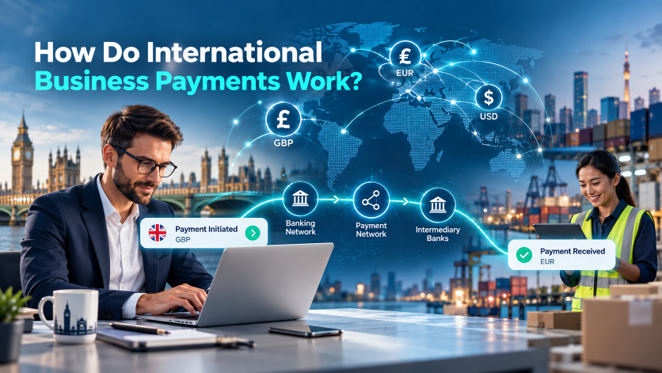
An international business payment generally follows five stages.
- The business enters the recipient’s payment details and selects the amount to send.
- If another currency is required, the payment provider converts the funds using an agreed exchange rate.
- The payment instruction moves through the relevant banking or payment network.
- Intermediary institutions may be involved depending on the currency, country and payment route.
- The recipient’s bank or payment provider credits the funds to the beneficiary account after completing any required checks. The exact process varies depending on the international payment system being used.
For example, SWIFT is a secure communication network used by banks and financial institutions for international financial transactions. SWIFT states that 90 percent of payments sent through its network reach the destination bank within an hour, although compliance checks, local regulations and processing at the receiving institution can affect when the beneficiary actually receives the money.
This is why two apparently similar international business money transfer transactions can have different processing times.
Why Do UK Businesses Make International Payments?
International trade means even relatively small UK companies may need to send or receive money overseas.
Common reasons include paying suppliers, purchasing inventory, working with international contractors, buying professional services, paying overseas partners and receiving revenue from customers in other countries.
Growing ecommerce, remote working and international supply chains have also made small business international payments more relevant to companies that previously operated only within the UK.
Paying Overseas Suppliers and Vendors
Paying overseas suppliers is one of the most common reasons businesses make overseas business payments.
A UK importer, for example, may receive an invoice from a European supplier in euros or an Asian manufacturer in another foreign currency.
When considering how to pay international vendors, businesses should review more than the advertised transfer fee.
Important factors include the amount the supplier needs to receive, the currency being sent, the exchange rate, payment charges, expected delivery time and whether intermediary fees may apply.
For recurring supplier payments, even a relatively small difference in the exchange rate can become more significant as payment volumes increase. Businesses should therefore compare the total cost of converting and transferring their money rather than looking at the transfer fee alone.
Receiving Payments from International Customers
International payments also work in the opposite direction.
UK businesses selling products or services overseas may receive payments in euros, US dollars and other currencies.
A business may choose to convert the payment into pounds when it arrives or, where suitable facilities are available, hold funds in the foreign currency until they are needed.
This can be particularly useful for a company that receives and makes payments in the same currency.
For example, a UK business receiving euros from European customers and paying European suppliers may be able to reduce unnecessary conversions by managing both sides of its currency flows carefully.
Types of International Business Payments
The best type of payment depends on who is being paid, the transaction value, payment frequency and the purpose of the transfer. For UK companies, the most relevant categories include B2B payments, SME payments and larger recurring international transactions.
B2B International Payments
B2B international payments are transactions between companies located in different countries.
Examples include a UK retailer paying an overseas manufacturer, a British company paying a foreign software provider or a distributor settling an invoice with an international supplier.
International B2B payments often involve higher values or recurring invoices, making cost transparency particularly important.
Businesses making frequent transactions should consider the full cost of each transfer, including currency conversion and any charges that may occur during the payment journey. For companies processing many international invoices, efficient B2B payment management can also reduce administrative work and improve visibility over outgoing cash flow.
Small Business and SME International Payments
SME international payments often involve smaller values than large corporate transactions, but the effect of payment fees and exchange rate movements can still be significant.
Common small business international payments include supplier invoices, contractor payments, online services, equipment purchases and overseas professional services.
SMEs should pay particular attention to:
- The exchange rate being offered
- The provider’s FX margin
- Transfer and receiving fees
- The expected payment time
- Supported currencies
- Customer support
- Payment tracking For a smaller business with tighter margins, knowing the complete payment cost before confirming a transaction can make budgeting easier.
International Payment Methods for UK Businesses
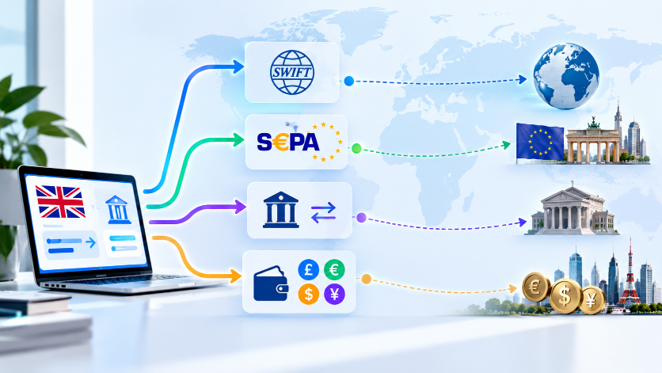
UK businesses have several ways to make international payments.
There is no single method that is suitable for every transaction. The appropriate option depends on where the money is going, which currency is required, how quickly it needs to arrive and how much the complete transaction will cost.
SWIFT Transfers
SWIFTis widely used to communicate international payment instructions between financial institutions. It is particularly relevant for global transfers where the sender and recipient banks need to communicate across different countries and banking systems.
A SWIFT payment can sometimes involve one or more intermediary institutions before reaching the receiving bank.
SWIFT itself does not simply move money like a standalone digital wallet. It provides the secure messaging infrastructure financial institutions use to exchange payment instructions.
For businesses, SWIFT can provide broad international reach, although total costs and delivery time may vary according to the payment route.
SEPA Payments
SEPA is designed to make euro payments across participating European countries and territories more standardised.
UK payment service providers can continue participating in SEPA schemes even though the UK is no longer an EU member state, subject to the relevant participation requirements.
SEPA can therefore remain relevant for UK companies making qualifying euro payments to European suppliers or receiving euro payments from customers.
Businesses should confirm whether their provider supports the required SEPA payment type and what fees or conversion costs apply.
Specialist Payment Providers and Multi Currency Accounts
Businesses are not limited to traditional bank transfers.
Specialist international payment services can provide foreign exchange and cross border payment facilities designed specifically for businesses.
A multi currency account can also allow a company to hold, receive and send selected currencies without converting every payment immediately into pounds.
This may be useful for businesses with regular international income and expenditure.
For example, a company receiving dollars and later paying a supplier in dollars may be able to avoid converting the same funds into pounds and then back into dollars.
When comparing specialist providers, businesses should review the actual exchange rate, FX margin, transfer fees, supported currencies, payment speed and regulatory status.
How Much Do International Business Payments Cost?
There is no universal price for business international payments.
The total cost depends on the provider, currency pair, amount, payment route and charges applied during processing.
Businesses should therefore compare the total amount sent with the amount the recipient is expected to receive.
Transfer Fees and Exchange Rate Margins
A transfer fee is the visible charge applied for processing a payment.
However, it may not represent the complete cost.
Currency conversion can include an FX margin. This is the difference between a reference market rate and the exchange rate offered to the customer.
For example, two providers could both advertise a low transfer fee while offering different exchange rates. The provider with the lower visible fee is therefore not automatically the cheaper option.
When considering how international business payment fees compare, businesses should review both the payment fee and the exchange rate before making a decision.
This is especially important for regular business FX payments, where small differences can accumulate across repeated transactions.
Intermediary and Receiving Bank Fees
Some international transfers pass through intermediary banks before reaching the final recipient.
An intermediary institution or receiving bank may apply additional charges depending on the payment route and account arrangements.
This can result in the recipient receiving less than the original amount sent.
Before making an important supplier payment, businesses should clarify who is responsible for different charges and whether additional fees could be deducted during processing.
Understanding this in advance can reduce disputes where an overseas supplier expects to receive the full invoice amount.
How to Reduce International Payment Costs and Choose a Provider
Businesses looking at how businesses reduce fees on international payments should focus on total payment cost rather than choosing a provider based on a single advertised fee.
Consider the following factors.
- Compare the exchange rate
Check the actual exchange rate offered for the transaction rather than relying only on claims about low fees.
- Understand the FX margin
Ask how the provider makes money from currency conversion and whether the margin is clearly disclosed.
- Review all payment charges
Check transfer fees, intermediary charges and possible receiving fees.
- Choose an appropriate payment route
Different currencies and destinations may be better suited to different payment networks.
- Consider payment frequency
Businesses making regular international payments may need different services from a company making one occasional transfer.
- Check supported currencies
Make sure the provider can support the countries and currencies important to the business.
- Review payment tracking and support
Being able to track a payment and speak to support can be particularly important for time sensitive supplier invoices.
- Check regulatory status
UK businesses should verify the regulatory status of any payment or electronic money firm they are considering.
The FCA strengthened safeguarding requirements for relevant UK payment and electronic money institutions from 7 May 2026. The requirements are intended to improve protection of relevant customer funds and strengthen record keeping, reporting and safeguarding practices.
A suitable provider should offer transparency around costs, currencies, processing and support rather than simply advertising a headline exchange rate.
How Long Do International Business Payments Take?

An international business payment can arrive quickly in some cases, while others may take longer depending on the route and circumstances.
The processing time can be affected by:
- The sending and receiving countries
- The currencies involved
- The payment method
- Intermediary institutions
- Banking cut off times
- Weekends and public holidays
- Compliance and security checks
- Incorrect or incomplete beneficiary information This is particularly relevant when considering how to handle delayed international business payments.
If a payment is delayed, the business should first confirm the beneficiary details, payment reference and payment status with its provider.
It should then determine whether the payment is still being processed, undergoing compliance checks or waiting at an intermediary or receiving institution.
Businesses making time sensitive supplier payments should avoid assuming that every international transfer will arrive immediately.
Allowing sufficient processing time can reduce the risk of late invoices and supply interruptions.
How Exchange Rates Affect International Business Payments
Exchange rates determine how much foreign currency a business receives when converting pounds or another currency.
This makes currency movements an important part of international payment planning.
Consider a UK company that needs to pay a fixed euro invoice in several weeks.
If sterling weakens against the euro before the payment is made, the business may need more pounds to purchase the same amount of euros.
If sterling strengthens, the payment may cost fewer pounds.
This uncertainty is known as foreign exchange risk.
For companies making frequent or high value global business payments, currency movements can influence costs, profit margins and cash flow.
Businesses may use spot transactions when they need to exchange currency at the current available rate.
Some businesses may also use forward contracts where appropriate. A forward contract allows an exchange rate for a future transaction to be agreed in advance, subject to the provider’s terms and the business’s circumstances.
The objective is not necessarily to predict where exchange rates will move. It is often to create greater certainty around future foreign currency costs.
A UK company should therefore consider both the payment itself and the currency exposure attached to it when planning international transactions.
FAQs About International Business Payments
What Is the Best Way for a UK Business to Make International Payments?
There is no single best method for every business.
The appropriate option depends on the currency, destination, transaction value, required speed, exchange rate and fees.
UK businesses should compare the complete cost of the transaction, including the FX margin and any possible additional charges, before choosing an international payment service.
How Can a UK Business Pay an Overseas Supplier?
A UK business can pay an overseas supplier using an international bank transfer, SWIFT, an eligible SEPA payment or a specialist payment provider depending on the destination and currency.
Before sending funds, confirm the supplier’s account details, invoice amount, payment currency, exchange rate, fees and expected arrival time.
For recurring overseas business payments, businesses should also consider whether their payment method remains cost effective as transaction volumes increase.
How Long Do International Business Payments Take?
International payment times vary.
The destination country, currency, payment system, intermediary institutions, banking hours and compliance checks can all influence processing.
Some payments can reach the receiving institution quickly, while others may require additional processing before the recipient receives the funds.
Businesses should check the estimated delivery time before confirming any urgent transaction.
What Fees Apply to International Business Payments?
International payments can involve transfer fees, currency conversion costs, FX margins, intermediary bank fees and receiving bank charges.
The cheapest advertised transfer fee does not necessarily mean the lowest total transaction cost.
Businesses should compare how much they pay with how much the recipient ultimately receives.
What Is the Difference Between SWIFT and SEPA?
SWIFT is a global financial messaging network used by banks and financial institutions to communicate payment instructions across international markets.
SEPA is focused on euro payments across participating European countries and territories.
For a UK business, the appropriate option depends mainly on the currency, destination and payment services available through its provider.
Final Thoughts
International business payments are now part of everyday operations for many UK companies, from SMEs paying their first overseas supplier to established organisations managing regular international transactions.
The most important consideration is not simply how to send money abroad. Businesses need to understand the exchange rate, FX margin, payment fees, processing time and payment route before committing funds.
A well planned approach to international payments for business can provide better visibility over costs, reduce unnecessary currency conversions and make overseas supplier and customer payments easier to manage. For UK businesses making regular international transactions, comparing payment options and understanding foreign exchange exposure should form part of normal financial planning.